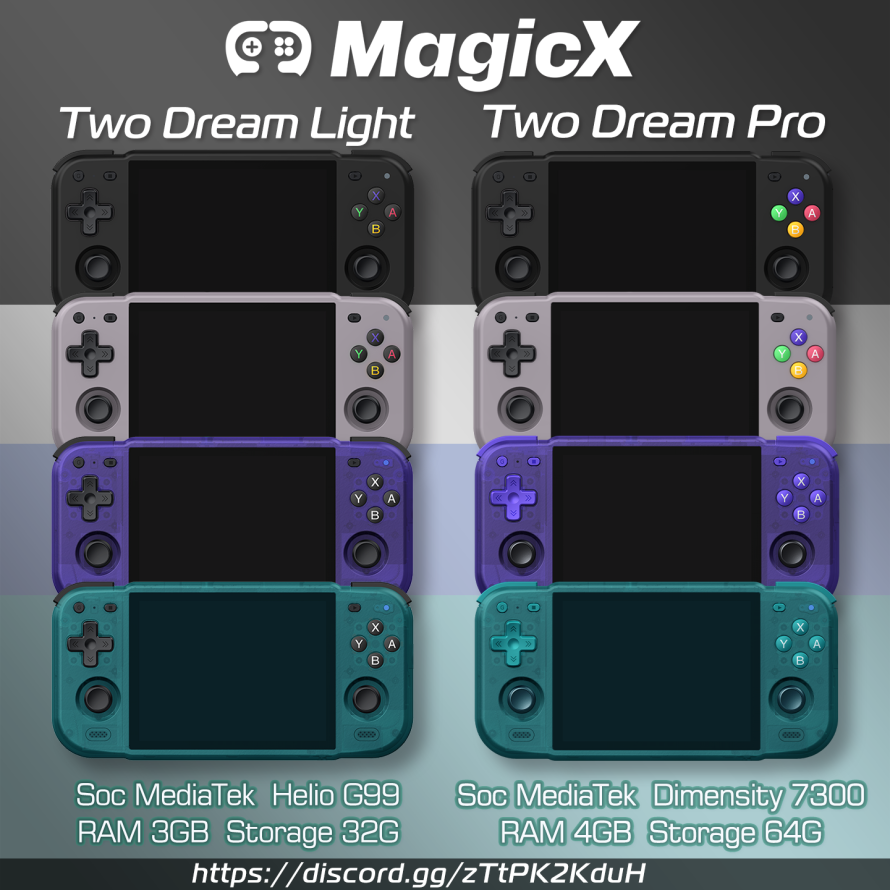
We joked at the end of our last article that if Anbernic didn't step up, we'd call MagicX. Turns out MagicX didn't wait for the call. The Chinese handheld maker has just revealed two new devices — the Two Dream Light and the Two Dream Pro — and the specs are the most ambitious they've ever announced.
MagicX has quietly been one of the more interesting players in the retro handheld space, occupying a niche somewhere between the budget-focused Anbernic crowd and the more premium end of the market. The Two Dream lineup is clearly a push upmarket — and the silicon choices signal they're serious about it.
Two Dream Light: The Helio G99
The entry point of the new lineup, the Two Dream Light, runs on the MediaTek Helio G99. If that chip sounds familiar, it should — it's been powering a wave of mid-range Android phones for the past couple of years, and it's proven itself as a solid performer in handheld gaming contexts.
The G99 is built on a 6nm process and pairs four Cortex-A76 performance cores with four Cortex-A55 efficiency cores, topped by a Mali-G57 GPU. In practical terms for emulation, that's enough to handle PlayStation 2 and GameCube titles with confidence, and pushes comfortably into Wii and early 3DS territory. It's not the most bleeding-edge chip on paper, but it's proven, well-understood, and — crucially — doesn't run hot.
Devices like the Retroid Pocket 4 have already shown what the G99 can do in a handheld form factor. The real question for the Two Dream Light will be the surrounding package: screen quality, battery size, build quality, and software support. The chip sets a high floor — execution will determine the ceiling.
Two Dream Pro: The Dimensity 7300
This is where things get genuinely exciting. The Two Dream Pro steps up to the MediaTek Dimensity 7300, and it represents a meaningful leap over the G99 in every meaningful metric.
The Dimensity 7300 is built on TSMC's 4nm process — a full two nodes ahead of the G99's 6nm. It features four Cortex-A78 performance cores and four Cortex-A55 efficiency cores, paired with a Mali-G615 GPU. That GPU upgrade in particular is significant: the Mali-G615 offers substantially better graphics throughput, which translates directly into smoother frame rates in demanding emulation targets like PS2, GameCube, Switch, and N64.
More importantly, the move to 4nm means the Dimensity 7300 can deliver that extra performance without a proportional increase in heat or power draw. For a handheld — where thermal headroom and battery life define the experience as much as raw specs do — that process advantage matters enormously.
If MagicX can pair the Dimensity 7300 with adequate cooling and a large enough battery, the Two Dream Pro could be one of the most capable handheld emulation devices at a non-premium price point.
A Two-Device Strategy
Launching two devices simultaneously at different price points is a smart move. It lets MagicX cover more of the market — the Light for buyers who want solid performance without paying a premium, and the Pro for enthusiasts chasing the best possible emulation experience.
It also signals that MagicX is thinking about product lines rather than one-off releases, which is how you build brand loyalty in a competitive market. Anbernic has long dominated by having a deep catalog at every price point. If MagicX can establish a credible two-tier lineup and back it up with good software support, they become a much more compelling alternative.
What We're Watching For
Specs are a promise. The handheld market is full of devices that looked great on paper and stumbled in practice — through thermal throttling, poor battery life, weak software, or build quality that didn't survive a pocket. MagicX has a decent track record, but the Two Dream lineup is their most ambitious bet yet.
The things that will make or break these devices:
- Thermals: Can the Two Dream Pro sustain the Dimensity 7300 at full speed without throttling? A 4nm chip runs cool in theory, but handheld enclosures are cramped.
- Battery life: The G99 and Dimensity 7300 are both efficient, but screen size and battery capacity will determine real-world session lengths.
- Software: Android-based handhelds live and die by their OS implementation. Proper button mapping, good EMU support, and timely updates matter as much as the SoC.
- Price: No pricing has been announced yet. The Two Dream lineup needs to hit the right numbers to compete — the G99 tier especially has plenty of competition.
Early Verdict
We called MagicX. They delivered. On paper, the Two Dream Light and Two Dream Pro are exactly the kind of devices the handheld space needs right now — thoughtful chip selections, a two-tier lineup, and the apparent intent to compete at the higher end of the market.
Whether they can turn a strong reveal into a strong launch is the real test. We'll be watching closely.
More details as they become available — pricing, release dates, and hands-on impressions incoming once review units start shipping.