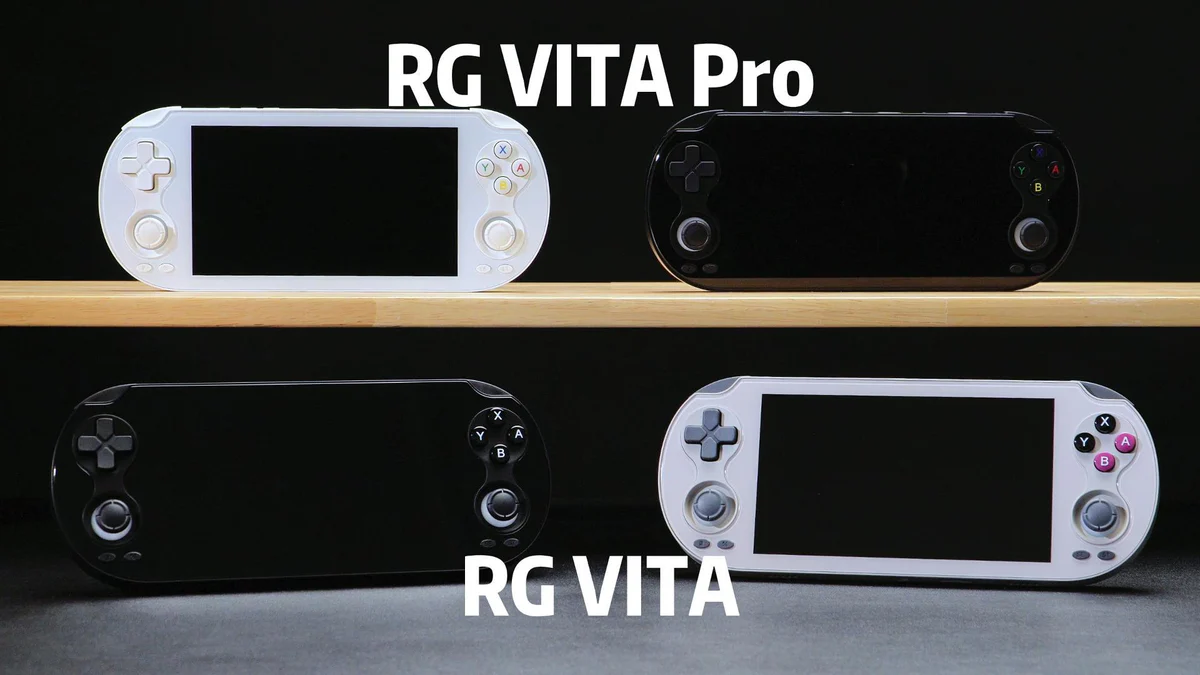
Anbernic has finally put prices on the RG Vita lineup, and pre-orders open March 23rd. There are two devices — a standard model and a Pro — and the gap between them is wider than the $40 price difference suggests. One is a safe, familiar Anbernic play. The other is a genuinely interesting bet on a new chipset.
Let's break down what you get at each tier, how they compare to the rest of the market, and why the Pro's choice of SoC might matter more than anything else on its spec sheet.
RG Vita: $99.99 Early Bird / $109.99 Retail
The standard RG Vita is the entry-level option, and the spec sheet reflects that clearly:
- SoC: Unisoc Tiger T618 (2× Cortex-A75 @ 2.0GHz + 6× Cortex-A55)
- GPU: Mali-G52 MP2
- RAM: 3GB LPDDR4X
- Storage: 64GB internal + microSD (up to 2TB)
- Display: 5.46-inch IPS, 1280×720, 60Hz
- Battery: 5,000mAh
- Connectivity: Wi-Fi 5, Bluetooth 5.0
- OS: Android 12
- Controls: Hall-effect analog sticks, stacked L1/R1/L2/R2
- Colors: Black and Gray
The T618 is a known quantity. It's the same chip Anbernic has been shipping in devices like the RG405M and RG505 for years now, and the emulation community has wrung every drop of performance out of it. You know exactly what it can do: PS1 is flawless, PSP runs great, N64 is solid, Dreamcast is reliable, and Saturn is playable for most titles. Some lighter PS2 games will run at playable framerates, but don't expect consistent full-speed PS2 or GameCube — the T618 simply doesn't have the GPU muscle.
At $110, the value proposition is decent but not remarkable. You're paying for the Vita-inspired form factor — the comfortable horizontal grip, the 5.46-inch screen, the overall feel of the thing. That form factor genuinely matters for extended play sessions. But hardware-for-dollar, you can get similar or better emulation capability from the Anbernic RG405M (same T618, metal shell, often found under $100) or the RG Cube (Unisoc T820, 8GB RAM, around $150 but significantly more powerful).
The standard RG Vita makes sense if you specifically want this form factor and your emulation needs stop at the PSP/Dreamcast tier. It's a solid device, but it's not pushing anything forward.
RG Vita Pro: $139.99 Early Bird / $149.99 Retail
The Pro is a different story. The $40 premium buys a genuinely different device:
- SoC: Rockchip RK3576 (4× Cortex-A72 @ 2.2GHz + 4× Cortex-A53 @ 1.8GHz)
- GPU: Mali-G52 MC3
- RAM: 4GB LPDDR4X
- Storage: 64GB eMCP + dual microSD slots
- Display: 5.5-inch IPS, 1920×1080, 60Hz
- Battery: 5,000mAh (18W USB-C PD charging)
- Connectivity: Wi-Fi 6, Bluetooth 5.2
- OS: Dual-boot Android 14 + 64-bit Linux
- Controls: Hall-effect analog sticks, stacked L1/R1/L2/R2
- Extras: HDMI/DisplayPort out, gyroscope
- Colors: Black and White
The jump from the standard model is significant. You get a full 1080p display instead of 720p. Wi-Fi 6 instead of Wi-Fi 5. Fast charging. Video output. A gyroscope. Dual microSD slots. And — most importantly — the Rockchip RK3576 instead of the aging T618.
But the real headline is the dual-boot capability. The RG Vita Pro ships with both Android 14 and a 64-bit Linux build. For emulation, this is significant. Linux has lower overhead than Android, which means more of the SoC's power goes directly to the emulator. Community firmware projects like GammaOS are already being developed for the RK3576, and Rockchip's relatively open approach to Linux kernel support gives developers a real foundation to build on.
At $150, the Pro lands in an interesting competitive bracket. It undercuts the Retroid Pocket 5 (Snapdragon 865, $200+) by a wide margin, and while the RP5 is the more powerful device — particularly for PS2, GameCube, and some Switch emulation — the Pro isn't trying to compete at that tier. It's targeting the space between budget T618 devices and flagship Snapdragon handhelds, and that's a space that has been genuinely underserved.
The RK3576: Why This Chip Matters
The most interesting thing about the RG Vita Pro isn't the device itself — it's the SoC inside it. The Rockchip RK3576 is a relatively new chip, and the RG Vita Pro is the first consumer retro handheld to ship with one.
That's worth pausing on. Right now, if you want an RK3576-powered handheld, the Anbernic RG Vita Pro is your only option. No other handheld maker has shipped a device with this chip yet.
The RK3576 does show up elsewhere, but exclusively in single-board computers and compute modules aimed at developers and hobbyists:
- Radxa ROCK 4D — A Raspberry Pi-sized SBC with the RK3576, up to 16GB RAM, targeting edge AI and multimedia workloads. Aimed at makers and embedded developers, not gamers.
- Radxa CM4 — A compute module using the RK3576 with a Raspberry Pi CM4-compatible form factor. Designed for integration into custom hardware, which theoretically includes DIY handheld builds — but nobody's done it at scale yet.
- FriendlyElec NanoPi R76S — A compact networking board running the RK3576, designed for router and firewall applications under OpenWrt. Not remotely a gaming device.
That's it. The entire RK3576 device landscape right now is Anbernic's handheld and a handful of dev boards. This makes the RG Vita Pro something of a pioneer — and that carries both upside and risk.
The upside: Rockchip chips have historically played well with the open-source community. The RK3326 powered an entire generation of budget handhelds (Anbernic RG351 series, Powkiddy RGB10), and the RK3566 did the same a tier up. If the RK3576 follows the same pattern, it could become the new default for mid-range retro handhelds over the next year or two. Early adopters of the RG Vita Pro would benefit from that maturing software ecosystem.
The risk: First-generation devices on a new chipset always have rougher software. The Linux build at launch will almost certainly have issues. Emulator cores may not be fully optimized for the A72/A53 cluster yet. And if the RK3576 doesn't gain broader adoption in handhelds, the community firmware support that makes Rockchip devices shine could be slower to materialize.
Brands like AYN, Powkiddy, and possibly Retroid are rumored to be evaluating the RK3576 for future models, but nothing has been announced. If even one more major manufacturer ships an RK3576 device, the firmware ecosystem benefits everyone — including RG Vita Pro owners.
Value Comparison: Where Do They Fit?
Here's how the two RG Vita models stack up against the current competition at nearby price points:
| Device | SoC | RAM | Display | Price | Max Tier |
|---|---|---|---|---|---|
| RG Vita | Unisoc T618 | 3GB | 5.46" 720p | $110 | PSP / Dreamcast |
| RG Vita Pro | Rockchip RK3576 | 4GB | 5.5" 1080p | $150 | GameCube / Wii |
| RG Cube | Unisoc T820 | 8GB | 3.95" 720×720 | ~$150 | GameCube / PS2 |
| Retroid Pocket 5 | Snapdragon 865 | 8GB | 5.5" 1080p AMOLED | ~$200 | PS2 / Switch (some) |
| GameMT EX8 | Helio G99 | 6GB | 5.5" 1080p 3:2 | $140 | GameCube / PS2 |
A few observations:
The standard RG Vita is the weakest spec-for-dollar in this group. At $110, you're getting a T618 with 3GB of RAM and a 720p screen. The form factor is the selling point, not the silicon. If you don't care about the Vita-style shell, the RG405M or even the aging RG505 offer similar or better emulation for less money.
The RG Vita Pro at $150 is more competitive, but faces stiff competition from the RG Cube. The Cube has a more powerful SoC (T820), double the RAM (8GB), and a proven emulation track record — but its square 3.95-inch screen is polarizing, and it lacks Linux dual-boot. If you want a widescreen 1080p display, comfortable grip, and the long-term upside of a new Rockchip platform, the Pro is the better pick. If you want raw emulation power today, the Cube probably edges it out.
The Retroid Pocket 5 remains the king of the $200 bracket, but it's also $50+ more expensive than the Pro. The Snapdragon 865 is a genuinely faster chip with a more mature GPU, and 8GB of RAM gives it headroom the Pro can't match. If PS2 and GameCube at consistent full speed are non-negotiable for you, the RP5 is still the device to beat at this price range.
Which One Should You Buy?
Buy the RG Vita ($110) if: You want a comfortable, Vita-style handheld for PS1, PSP, Dreamcast, and lighter emulation. You don't need cutting-edge performance, you like the form factor, and you want something reliable and familiar out of the box.
Buy the RG Vita Pro ($150) if: You want the same form factor but with meaningful upgrades — 1080p screen, dual-boot Linux, Wi-Fi 6, video out — and you're willing to bet on the RK3576 maturing into a well-supported platform. The Pro is the more interesting device, and the $40 premium over the standard model is easy to justify given how much more you get.
Skip both if: You already own an RG Cube or Retroid Pocket 5 and are happy with the emulation performance. Neither RG Vita model offers a compelling reason to sidegrade from those devices unless the form factor is a strong draw for you.
The Bottom Line
The RG Vita lineup is a classic Anbernic two-tier play: a safe, affordable standard model and a more ambitious Pro variant that takes a genuine risk on new silicon. The standard model will sell fine on form factor alone, but the RG Vita Pro is the one worth paying attention to. It's the first retro handheld to ship with the Rockchip RK3576, and that matters — not just for what it can do at launch, but for where the software ecosystem around it goes over the next year.
Pre-orders open March 23rd. Early bird pricing — $99.99 for the standard, $139.99 for the Pro — is available for the first 72 hours.