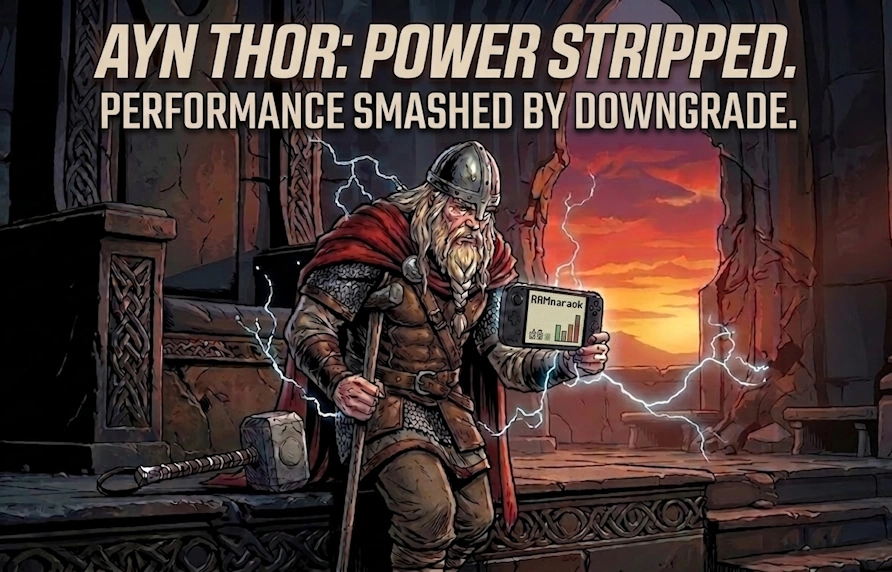
Just weeks after raising prices across their entire lineup due to the DRAM shortage, AYN is facing another component crisis — this time with UFS storage. In a Discord announcement on April 16, 2026, the company revealed that future batches of the Thor and Odin 3 will transition from UFS 4.0 to UFS 3.1 storage, and the Thor Max is getting another price increase.
The component supply crisis that began with RAM has now spread to storage, and AYN is being forced to make difficult tradeoffs to keep their flagship devices in production.
What's Changing
Starting with Thor Batch 6 and Odin 3 Batch 7, all new pre-orders will ship with UFS 3.1 storage instead of UFS 4.0. According to AYN, supply shortages and significant cost increases have made UFS 4.0 "no longer available at a sustainable level."
In an effort to maintain existing pricing for the Thor Base and Pro models, AYN absorbed the cost increase on those SKUs. However, the 1TB UFS price surge was too substantial to absorb entirely. The Thor Max (16GB RAM + 1TB storage) is now priced at $549 — up $60 from the already-increased $489 price announced just a month ago, and $100 higher than the original $449 launch price.
On a more positive note, AYN is introducing a new middle-tier configuration: 16GB RAM with 512GB storage, priced at $469. This gives buyers access to the top-tier RAM configuration without paying the premium for 1TB UFS storage, which has become disproportionately expensive.
UFS 3.1 vs. UFS 4.0: What You're Losing
UFS 4.0 was one of the headline features of both the Thor and Odin 3 — marketed as a premium specification that would deliver faster game loading, app launches, and file transfers. Downgrading to UFS 3.1 is a meaningful step backward on paper. Here's how the two standards compare:
- UFS 4.0: Sequential read speeds up to ~4200 MB/s, sequential write speeds up to ~2800 MB/s
- UFS 3.1: Sequential read speeds up to ~2100 MB/s, sequential write speeds up to ~1200 MB/s
That's roughly a 2x performance difference in both read and write speeds. In real-world usage, you'll notice this most when:
- Loading large games (PS2, GameCube, Switch)
- Launching Android apps and switching between them
- Transferring ROM libraries to and from the device
- Recording or processing video
For lighter emulation workloads — PS1, GBA, SNES — the difference will be negligible. But for users pushing the limits of what the Snapdragon Elite can emulate, the slower storage will be noticeable, particularly on games with frequent loading screens or open-world titles that stream assets continuously.
It's worth noting that UFS 3.1 is still significantly faster than the eMMC storage found in budget retro handhelds, and it's the same standard used in many flagship Android phones from 2021-2023. This isn't a disaster, but it is a downgrade from what was promised and what earlier batches delivered.
The Component Crisis Deepens
The shift from UFS 4.0 to UFS 3.1 follows the same supply chain dynamics that caused the RAMpocalypse just weeks ago. As we covered in March, the AI boom has reallocated global semiconductor manufacturing capacity toward high-margin enterprise products. Memory manufacturers like Samsung, SK Hynix, and Micron are prioritizing data center and AI infrastructure over consumer electronics.
NAND flash storage — the foundation of UFS — is facing the same pressure. High-performance storage is being funneled toward enterprise SSDs and server-grade products, leaving consumer-facing manufacturers scrambling for supply. UFS 4.0, being the newest and highest-performance standard, is hit hardest. It's expensive, limited in supply, and increasingly reserved for flagship smartphones with the purchasing power to lock in allocation.
For smaller manufacturers like AYN, the math doesn't work. When UFS 4.0 costs double what UFS 3.1 does — and may not even be available in the quantities needed for a production run — downgrading becomes the only viable option.
New SKU: The 16GB/512GB Sweet Spot
The introduction of a 16GB RAM + 512GB storage configuration at $469 is likely the smartest move AYN could make in this environment. It gives buyers who want maximum RAM for multitasking and demanding emulation a way to get it without paying the inflated cost of 1TB storage.
For most users, 512GB is plenty. If you're primarily running emulators and ROM libraries, even large collections of GameCube, PS2, and Switch games can fit comfortably in that space. And with SD card expansion available, the storage cap is less of a hard limit than it would be on a phone or laptop.
This SKU essentially splits the difference between the Thor Pro ($399, 12GB RAM / 256GB storage) and the Thor Max ($549, 16GB RAM / 1TB storage), offering a more balanced value proposition for users who prioritize performance over maximum capacity.
The Bigger Picture
AYN's transparency continues to set them apart in an industry where most manufacturers would have made this change silently. But transparency doesn't change the fundamental problem: the retro handheld market is being squeezed by forces entirely outside its control.
In March, it was RAM. Now it's UFS storage. Next month, it could be display panels or battery cells. The entire consumer electronics supply chain is being restructured around AI infrastructure, and small-to-mid-size manufacturers are losing access to the components that made affordable, high-performance devices possible.
AYN has done what they can — absorbing costs on some SKUs, introducing new configurations to offer better value, and being upfront about why these changes are happening. But the trend is undeniable: retro handhelds are getting more expensive, and the specs are getting worse.
If you were considering a Thor or Odin 3 and can afford it now, locking in a pre-order before the next round of price increases might be worth it. And if you already own a device from an earlier batch with UFS 4.0, you're holding hardware that future buyers won't be able to get — at least not at any reasonable price.
What This Means for Buyers
If you're ordering from Thor Batch 6 or Odin 3 Batch 7 onward, here's what you need to know:
- All new units will have UFS 3.1, not UFS 4.0. Expect slower storage performance compared to earlier batches and marketing materials.
- Thor Max is now $549. That's $100 more than launch price, and there's no guarantee it won't increase again.
- The new 16GB/512GB SKU at $469 is probably the best value. You get the top-tier RAM without overpaying for 1TB in a constrained market.
- Earlier batches with UFS 4.0 are now legacy hardware. If you can find one on the used market, it may be worth a premium.
The component crisis isn't going away. As we've seen with RAM, these shortages can persist for years. AYN is doing what they can to navigate it, but the bottom line is clear: the era of cheap, high-performance retro handhelds is over — at least for now.