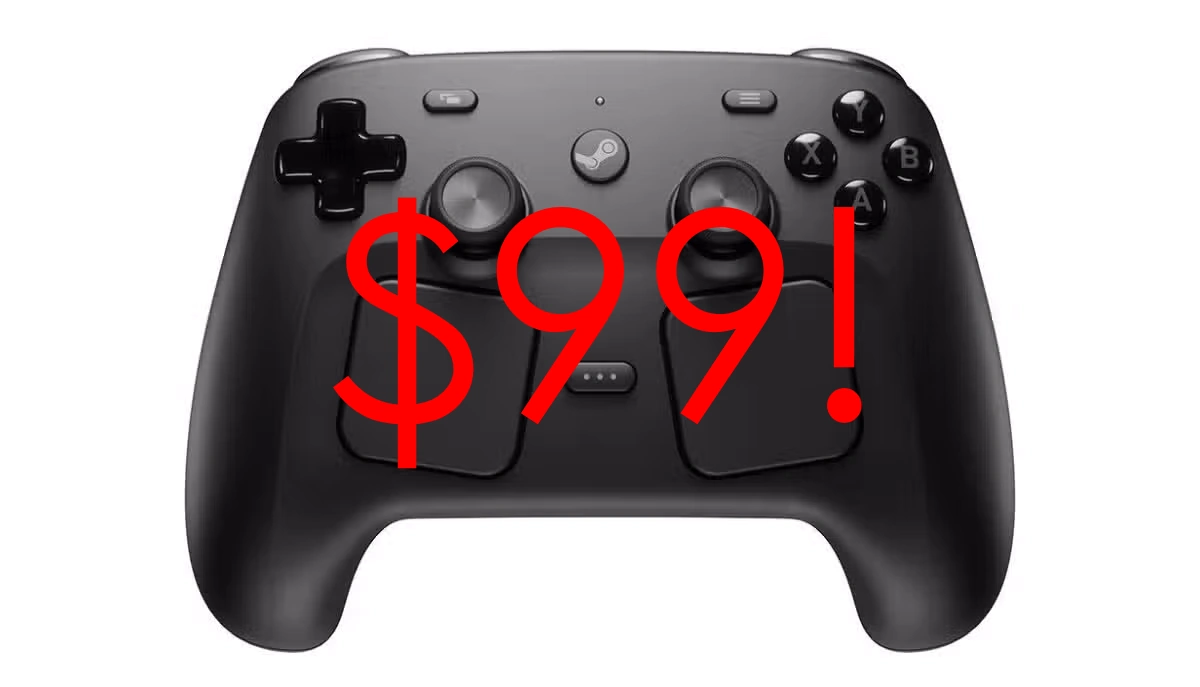
Valve has officially announced pricing for the Steam Controller, and it's coming in at $99 — a price point that puts it squarely in premium territory alongside the $149 Xbox Elite Series 2 and well above the $69 standard Xbox Series X controller or $74 PlayStation 5 DualSense. Launching May 4, 2026, the controller combines traditional thumbsticks with Steam Deck-inspired trackpads, TMR magnetic sensors, and a 35-hour battery, but the eye-watering price has raised serious questions in the PC gaming community.
While the technology inside is undeniably impressive, the Steam Controller is also missing some features that have become standard on competing premium controllers — and its price point may be a preview of what to expect when Valve finally announces Steam Machine pricing.
What You're Getting for $100
Valve isn't charging $99 for a standard gamepad. The new Steam Controller takes lessons learned from the Steam Deck and applies them to a standalone controller, combining traditional inputs with PC-focused innovations. At this price point, it's competing directly with elite-tier controllers. Here's what justifies the cost:
TMR Magnetic Thumbsticks: Beyond Hall Effect
The Steam Controller's standout hardware feature is its TMR (Tunneling Magnetoresistance) magnetic thumbsticks — a technology that's actually superior to the Hall Effect sensors found in most premium controllers. TMR measures electrical resistance caused by magnetic fields, resulting in higher precision, better energy efficiency, and complete immunity to stick drift.
These aren't just marketing buzzwords. TMR sensors offer higher resolution than standard Hall Effect alternatives, which translates to smoother, more accurate inputs in fast-paced games like shooters and racing sims. Combined with TMR-equipped analog triggers, the Steam Controller delivers drift-free performance that should outlast standard controllers by years.
For a market plagued by drift issues on $70 controllers, this alone is a compelling reason to consider the upgrade — assuming Valve's claims hold up over time.
Dual Trackpads Borrowed from Steam Deck
Unlike the original Steam Controller, which controversially replaced the right analog stick with a trackpad, the new model includes both traditional thumbsticks and dual trackpads. This hybrid approach mirrors the Steam Deck's successful input layout, giving players the best of both worlds.
The trackpads support haptic feedback, pressure-sensitive inputs, and can simulate precise mouse movements for strategy games, menu navigation, or any scenario where a thumbstick falls short. They're not mandatory — you can play traditional gamepad games without touching them — but for PC-specific titles, they're invaluable.
35+ Hour Battery Life with Magnetic Charging Puck
Battery life is where the Steam Controller truly shines. The 8.39 Wh lithium-ion battery delivers over 35 hours of gameplay — significantly longer than the Xbox Series X controller (around 30 hours with AA batteries) and vastly superior to the DualSense's 12-15 hour runtime.
Charging is handled via the included Steam Controller Puck, a magnetic dock that doubles as a 2.4GHz wireless receiver. The puck maintains a consistent 8ms latency even with four controllers connected, and the magnetic connection makes docking effortless. It's a far more elegant solution than fumbling with USB-C cables or proprietary charging docks.
Back Buttons and Gyro Support
The Steam Controller includes rear grip buttons (similar to the Steam Deck and Xbox Elite controllers) and a built-in gyroscope for motion aiming. Gyro support has become table stakes for PC controllers, particularly in competitive shooters where it can bridge the gap between controller and mouse precision.
Combined with Steam's extensive remapping tools, every input can be customized per-game, with community-shared profiles available for thousands of titles. This level of flexibility is unmatched outside of Valve's ecosystem.
Find My Controller Feature
In a delightful touch, the Steam Controller includes a "Find My Controller" feature that triggers vibration and an audible ping when you can't locate it. According to Valve designer Lawrence Yang, an engineer simply "thought it was a good noise and funny" and the team kept it. It's a small quality-of-life feature that feels straight out of the AirPods playbook, and it's genuinely useful.
Built for Repairability
Unlike most modern controllers, the Steam Controller is designed to be opened and repaired. Seven Torx screws on the back provide tool-free access to the internals, and battery replacement is straightforward. Valve plans to release 3D scans and schematics for modders, encouraging customization and long-term sustainability.
In an industry increasingly hostile to right-to-repair, this is a standout feature that adds real long-term value — especially at a $99 price point.
What's Missing
For all its innovation, the Steam Controller is conspicuously missing some features that have become expected on $99+ gamepads:
No 3.5mm Headphone Jack
The most controversial omission is the lack of a 3.5mm headphone jack. According to Valve engineer Jeremy Slocum, the decision was made because "a lot of people are using other types of technology with PCs" — Bluetooth headsets or gaming headsets with USB dongles — making the jack unnecessary.
While this reasoning makes sense for PC gamers, it's a frustrating choice for users who prefer wired audio or want the flexibility of plugging in any headset. The Xbox Elite Series 2 and PlayStation DualSense both include headphone jacks at similar or lower price points, making this omission harder to justify.
No Trigger Locks
Despite competing with the Xbox Elite Series 2, the Steam Controller lacks physical trigger locks — a feature that allows players to shorten trigger travel for faster inputs in competitive shooters and racing games.
While the TMR-equipped triggers support dual-stage bindings in software, there's no way to physically limit trigger travel. For competitive players who swear by hair-trigger responsiveness, this is a meaningful downside at a $99 price point.
No Swappable Components
Unlike the Xbox Elite controller, the Steam Controller doesn't offer swappable thumbsticks, D-pads, or removable back buttons. The design is fixed, and while it's repairable, it's not modular.
Valve's focus on repairability and 3D printable parts suggests they're encouraging community customization rather than offering official swappable components, but it's still a limitation compared to other elite-tier controllers.
No Heartbeat Sensor
In a move that will surely disappoint dozens of users, the Steam Controller does not include a built-in heartbeat sensor — a feature recently introduced on select Anbernic retro handhelds for... reasons that remain unclear. Valve has confirmed there are no plans to add biometric monitoring, sleep tracking, or stress level detection to future revisions.
This is almost certainly fine. If your controller needs to know your heart rate, you're either playing Elden Ring or should probably take a break.
What This Means for Steam Machine Pricing
The $99 price tag on the Steam Controller is notable not just for what it says about the controller, but for what it might signal about the upcoming Steam Machine lineup. Valve has yet to announce official pricing for Steam Machines, but the controller's shockingly high cost suggests Valve has completely abandoned any notion of competing on price.
If a controller — traditionally a $60-$75 accessory — is priced at nearly $100, it's a clear warning sign that Steam Machines will be positioned well into premium territory. Early partner announcements have hinted at systems ranging from $500 to over $1,000, and Valve's messaging has focused on performance, customization, and living room integration rather than affordability. But a $99 controller suggests even the lower end of that range might be optimistic.
For PC gamers hoping Steam Machines would undercut consoles on price, the Steam Controller's announcement is a stark reality check. Valve is building a premium ecosystem with premium pricing across the board, and the barrier to entry is looking significantly higher than many anticipated.
Should You Pre-Order?
The Steam Controller launches May 4, 2026, exclusively through the Steam store for $99 (£85 UK, €99 EU). Whether it's worth the price depends entirely on what kind of PC gamer you are — and how much you value the features Valve is offering over standard controllers.
You should consider it if:
- You want drift-proof TMR magnetic sticks that will outlast standard controllers
- You play PC-focused games (strategy, MOBAs, sims) that benefit from trackpad precision
- You value battery life and appreciate 35+ hours between charges
- You're invested in the Steam ecosystem and want seamless integration
- You care about repairability and long-term sustainability
You should skip it if:
- You only play games that work perfectly with standard Xbox or PlayStation controllers
- You need a 3.5mm headphone jack and won't use wireless audio
- You want trigger locks or other competitive features found on the Xbox Elite
- You're looking for the cheapest way to play PC games (an Xbox Series X controller is $69)
- You don't care about trackpads, long battery life, or Steam-specific features
The Steam Controller is Valve's most refined gamepad yet, combining proven inputs with innovative features like TMR sticks, dual trackpads, and exceptional battery life. But at $99, it's asking PC gamers to pay a 40% premium over a standard Xbox controller for features that, while impressive on paper, may not be essential for everyone.
The real value proposition comes down to longevity and PC-specific functionality. If drift-proof sticks, trackpad precision, and 35-hour battery life matter to you, the Steam Controller starts to make sense. But if you just want a reliable gamepad for Steam games, an Xbox controller will do the job for $30 less.
And if a controller costs $99, brace yourself for what Steam Machines are going to cost. This pricing announcement doesn't inspire confidence in Valve's vision for affordable living room PC gaming.