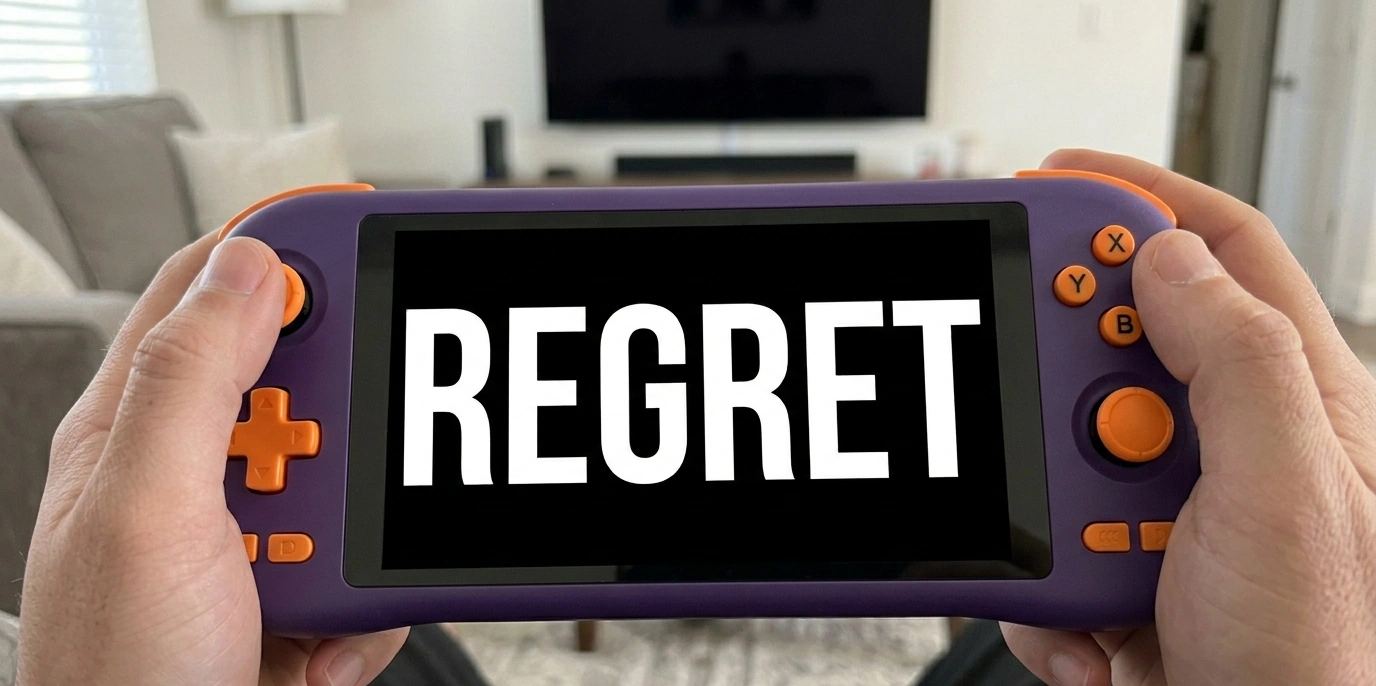
When I set out to buy a budget Android handheld, the decision seemed straightforward: choose the device with the most powerful specs. On paper, the KinHank K56 dominated the Mangmi Air X — better processor, more RAM, faster storage. I found a K56 second-hand for around $70 USD and pulled the trigger, confident I'd made the smart choice. Spoiler: I was wrong.
Within a week of using the K56, I realized I'd made a classic mistake: prioritizing raw power over the fundamentals that make a handheld actually enjoyable to use. The Mangmi Air X, despite being less powerful on paper, delivers a significantly better experience thanks to superior build quality, a noticeably better screen, and controls that don't feel like they'll break after a month.
Here's why specs aren't everything — and why the Mangmi Air X is the better buy for most people, especially first-time handheld buyers on a budget.
The Specs: KinHank K56 Wins on Paper
Let's get the obvious out of the way: the KinHank K56 is more powerful than the Mangmi Air X. If you're comparing spec sheets side-by-side, the K56 looks like the clear winner.
| Spec | KinHank K56 | Mangmi Air X |
|---|---|---|
| Processor | Unisoc 9230S (A75 @ 2.2GHz + A55 @ 1.8GHz) |
Snapdragon 662 (4×A73 @ 2.1GHz + 4×A53 @ 2.0GHz) |
| RAM | 6GB LPDDR4X | 4GB LPDDR4X |
| Storage | 128GB UFS 2.0 | 64GB eMMC |
| GPU | Mali-G57 @ 850MHz | Adreno 610 @ 1050MHz |
| Screen | 5.5" LCD, 1920×1080 | 5.5" IPS, 1920×1080, 400 nits |
| Battery | 5000mAh (~8 hours) | 5000mAh, 15W charging (~8 hours) |
| OS | Android 14 | Android 14 |
| Price | ~$140 new (~$70 used) | ~$90-100 |
On specs alone, the K56 has 50% more RAM, double the storage with faster UFS 2.0 vs eMMC, and a slightly more powerful processor. Both have 1080p screens, but the Mangmi Air X has a superior IPS panel with better brightness and color accuracy. In theory, the K56's extra power means better performance in demanding emulators like Dolphin (GameCube) and PPSSPP (PSP), with more headroom for multitasking and storing games locally.
And that's exactly what sold me. I found one second-hand for around $70 USD — roughly the same price as a new Mangmi Air X — and thought: "Why settle for less power when I can get significantly better specs at the same price point?"
The Problem: I Already Had an Odin 2
Here's the thing I didn't fully consider when I bought the K56: I already owned an AYN Odin 2 for playing PS2 and GameCube games. The Odin 2 is purpose-built for higher-end emulation, with significantly more power than either the K56 or the Mangmi Air X. So why was I buying a second device that overlapped with what the Odin 2 already did better?
The answer, I realized too late, was that I didn't need another powerhouse. What I actually wanted was a comfortable, well-built handheld for lighter retro gaming — something portable and enjoyable to use for NES, SNES, Genesis, GBA, and PS1 games. I wanted a device that felt good in my hands, not one that could theoretically push a few more frames in Burnout 3.
The K56's extra power was solving a problem I didn't have. The Mangmi Air X, on the other hand, would have been perfect for what I actually needed.
Where the KinHank K56 Falls Apart: Build Quality
Specs only matter if the device is pleasant to use. The KinHank K56 is not.
The Buttons and D-Pad Are Bad
Let me be blunt: the K56's buttons are terrible. The face buttons feel cheap and mushy, with inconsistent tactile feedback that makes precise inputs frustrating. There's no satisfying click or defined travel — just a spongy, unreliable press that feels like it came off a $20 knockoff controller.
The d-pad is somehow even worse. It's imprecise, mushy, and feels like it's fighting you on diagonal inputs. After a few hours of Street Fighter II, I was actively dreading quarter-circle motions. For a device marketed for retro gaming — where d-pad quality can make or break the experience — this is a dealbreaker. The Mangmi Air X's d-pad, by contrast, is responsive and accurate, making platformers and fighting games actually enjoyable to play.
Even worse, the shoulder buttons feel fragile and hollow. There's a plasticky quality to them that makes me genuinely worried they'll snap off if I press too hard during a tense session. At $70 second-hand, this is disappointing. At the $140 retail price? It's completely unacceptable.
The Screen Quality Is Disappointing
While both devices have 1080p screens on paper, the panel quality is noticeably different. The K56's LCD panel has washed out colors, poor viewing angles, and inconsistent brightness. Some product listings claim the K56 uses an IPS panel, but in practice, it feels more like a basic LCD with mediocre color reproduction.
The Mangmi Air X, by contrast, uses a true IPS panel with 400 nits of brightness and significantly better color accuracy. Side-by-side, the difference is night and day — you're getting a brighter, more vibrant display with better viewing angles on the cheaper device. For retro gaming — where pixel art and vibrant 16-bit colors are half the appeal — the Mangmi's screen is a massive upgrade.
Build Quality Feels Budget
The K56's plastic shell feels hollow and creaky. There's noticeable flex in the body, and the seams don't line up perfectly. It's not unusable, but it doesn't inspire confidence. The Mangmi Air X, despite being cheaper, feels more solid and better assembled. Reviews consistently praise the Air X's build quality, especially at its price point.
What the KinHank K56 Does Better (And Why It Doesn't Matter)
To be fair, the K56's extra power does unlock some additional emulation capabilities. The Unisoc 9230S can handle some GameCube and Wii games at playable framerates, whereas the Snapdragon 662 in the Mangmi Air X struggles with anything beyond PS1 and Dreamcast.
Systems the K56 can handle that the Mangmi Air X can't:
- GameCube (some games, not all)
- Wii (lighter titles)
- PS2 (very hit-or-miss)
- 3DS (select games)
But here's the problem: if you're serious about playing those systems, you shouldn't be using either of these devices. You should be using something like an AYN Odin 2, Retroid Pocket 4 Pro, or one of the higher-tier handhelds with Snapdragon 845+ chips or better. The K56 can technically run some of these games, but the experience is often janky, inconsistent, and frustrating.
Even at the similar price point I paid for my second-hand K56, the extra emulation performance isn't worth the sacrifice in build quality, screen quality, and overall user experience. If you're buying new and paying the $40-50 premium for a K56, the value proposition gets even worse.
The Takeaway: User Experience Beats Raw Power
If I could go back and make the decision again, I'd buy the Mangmi Air X without hesitation. Here's why:
The Mangmi Air X Is Easier to Recommend
The Mangmi Air X is a fantastic first retro handheld. It's affordable (~$90-100), well-built, and perfectly capable of handling the systems most people actually want to play: NES, SNES, Genesis, Game Boy, GBA, PS1, and even Dreamcast and PSP. The controls are solid, the screen is excellent, and the overall experience feels polished.
For someone new to retro handhelds, the Air X is a safe bet. It won't break the bank, it won't fall apart after a month, and it delivers exactly what it promises: a great way to play classic games on the go.
The Mangmi Air X Has Better Software Support
Here's another advantage the Mangmi Air X has over the K56: it's getting a version of GammaOS soon. GammaOS is a custom firmware focused on improved performance and better emulation optimization, and its upcoming support for the Air X means the device will only get better over time.
Even more importantly, the Mangmi Air X's Snapdragon 662 chip — despite being technically less powerful than the K56's Unisoc processor — is significantly better for PC gaming through GameNative. Snapdragon chips have far better compatibility and optimization for running native PC games compared to obscure Unisoc processors. While the K56 might have more raw power for emulation, the Mangmi Air X will actually let you play lightweight PC games and ports with better stability and performance.
This is a perfect example of why raw specs don't tell the whole story. The Mangmi's "weaker" Snapdragon chip has better software support, better developer attention, and better real-world compatibility than the K56's Unisoc processor.
The KinHank K56 Is a Hard Device to Recommend
The K56, on the other hand, sits in an awkward middle ground. Even second-hand at around $70, the poor build quality undermines the value. At the $140 retail price, it's nearly impossible to recommend. The extra power is nice in theory, but in practice, it's solving a problem most users don't have — especially if they already own a more capable device for higher-end emulation.
If you're going to spend $140 on a new handheld, you're better off saving a bit more and getting something truly capable like a Retroid Pocket 4 Pro or AYN Odin 2 Mini. If you're looking for a budget option around $70-100, the Mangmi Air X is the smarter choice — better build quality at a similar or lower price point.
Build Quality and User Experience Matter More Than Specs
This experience taught me an important lesson: specs aren't everything. A device with lower numbers on paper but better build quality, a superior screen, and thoughtful design will deliver a better experience than a spec-sheet champion with cheap buttons and a mediocre display.
The Mangmi Air X understands this. It doesn't try to be the most powerful handheld on the market — it tries to be the best experience in its price range. And it succeeds.
Final Verdict: Buy the Mangmi Air X
If you're shopping for a budget Android retro handheld and deciding between the KinHank K56 and Mangmi Air X, get the Mangmi Air X. It's cheaper, better-built, has a superior screen, and delivers a more enjoyable overall experience. Unless you absolutely need the K56's extra power for specific emulation use cases (and you probably don't), the Air X is the better buy.
The K56 is a hard device to recommend. Even at the $70 second-hand price I paid, I wish I'd bought the Mangmi Air X instead. At the $140 retail price, it's borderline inexcusable given the build quality issues. The Mangmi Air X, on the other hand, is one of the best budget retro handhelds you can buy in 2026 — and it's the device I wish I'd bought in the first place.
What Happens to My K56?
So what am I doing with the KinHank K56? I'm giving it to thegammasqueeze. While the device itself disappointed me as a daily driver, there's one aspect of it that's genuinely interesting: the Unisoc T620 chipset.
The T620 (also marketed as the Unisoc 9230S in some variants) is an unusual processor that doesn't get a lot of coverage in the retro handheld space. For someone who enjoys testing obscure hardware, benchmarking emulation performance across different chipsets, and documenting how various SoCs handle different systems, the K56 is actually a valuable data point — even if it's not a great handheld to actually use.
The most interesting thing about the K56 isn't the gaming experience. It's the chipset itself. And that's exactly the kind of hardware thegammasqueeze will appreciate far more than I ever could.
TL;DR: I bought the KinHank K56 for its power and regretted it. The Mangmi Air X has better build quality, a better screen, and costs less. For most people — especially first-time buyers — the Mangmi Air X is the smarter choice. Don't make my mistake: choose user experience over specs.