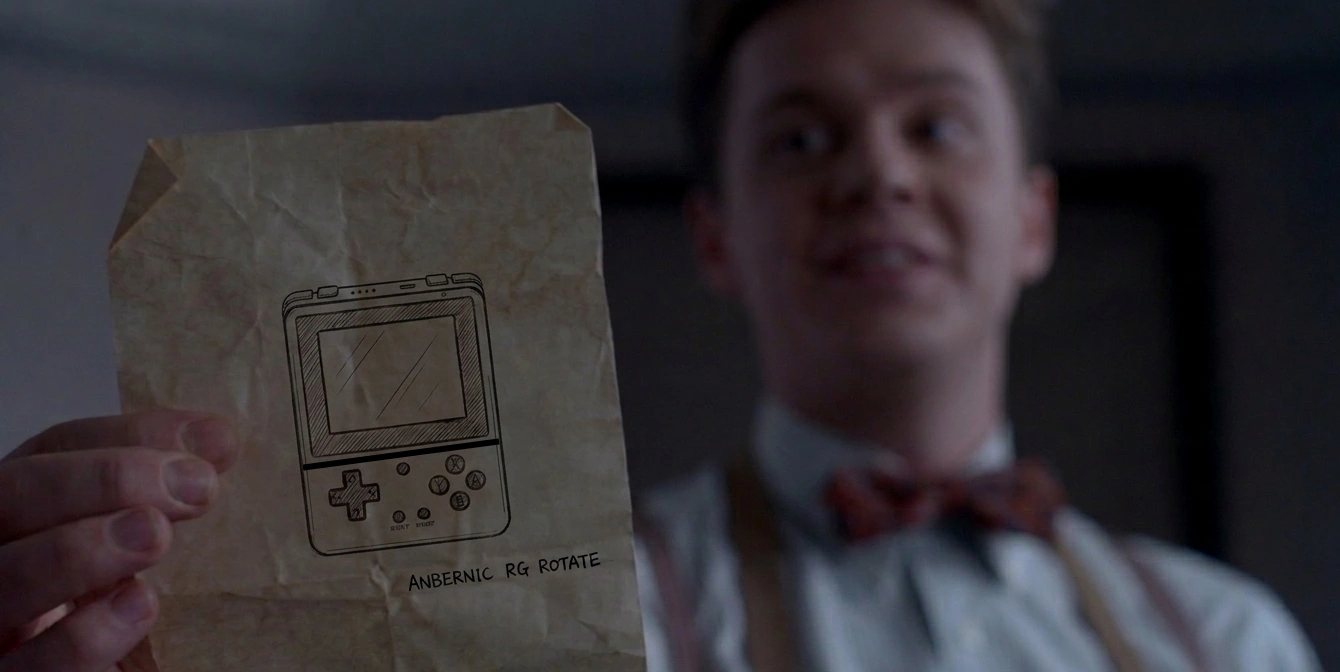
I ordered the Anbernic RG Rotate in black plastic from retail for what seemed like $83 — until I realized shipping added another $22. That puts the real cost at $105, which makes this one of the strangest value propositions in the retro handheld space right now. The rotating screen gimmick is interesting but limited in practical use. The Unisoc T618 chip is a known quantity but aging. And the controls are barely adequate for anything beyond PS1.
So why did I buy it? Because I wasn't looking for a gaming handheld. I was looking for a digital audio player for myself and my kids — one that's just powerful enough to run music apps and light retro games, but not powerful enough to run Roblox, Minecraft, or Fortnite.
And for that specific, narrow use case, the RG Rotate is actually perfect.
The Hidden Cost: Shipping Makes This a $105 Device
Let's start with the pricing, because it's more misleading than it appears. The retail listing shows $83 for the black plastic model, which sounds competitive — especially compared to other budget Android handhelds in the $100-150 range. But when you get to checkout, shipping adds another $22, bringing the real cost to $105.
That $22 shipping fee isn't negligible. It pushes the RG Rotate into the same price bracket as devices like the Anbernic RG405M (Unisoc T618, often under $100) and the Mangmi Air X (Snapdragon 662, around $90-100), both of which have significantly more powerful processors and better gaming performance. At $83, the RG Rotate's rotating screen gimmick might be interesting enough to justify the purchase. At $105, it's a much harder sell — unless you're buying it for a specific use case like I was.
I'm still waiting for mine to ship, so I haven't seen it in person yet. But based on the specs and reviews, I know exactly what I'm getting — and more importantly, what I'm not getting.
The Specs: Unisoc T618 and Why That Matters
The RG Rotate runs on the Unisoc T618, the same chipset Anbernic has been using in devices like the RG405M and RG505 for years. It's a known quantity in the retro handheld space. Here's the full spec breakdown:
- SoC: Unisoc T618 (2× Cortex-A75 @ 2.0GHz + 6× Cortex-A55 @ 1.8GHz)
- GPU: Mali-G52 MP2
- RAM: 3GB LPDDR4X
- Storage: 32GB internal + microSD (up to 512GB)
- Display: 3.5-inch IPS, 640×480 (4:3), rotating hinge
- Battery: 2,000mAh
- Connectivity: Wi-Fi 5, Bluetooth 5.0
- OS: Android 12 (stock firmware)
- Controls: Standard D-pad and face buttons, L1/R1/L2/R2 shoulders
- Price: $83 + $22 shipping = $105
The T618 is a known quantity. It's the same chip Anbernic has been shipping in devices like the RG405M and RG505 for years, and the emulation community has wrung every drop of performance out of it. PS1 is flawless, PSP runs great, N64 is solid, Dreamcast is reliable, and lighter PSP games are playable. Some lighter PS2 games will run at playable framerates, but don't expect consistent full-speed PS2 or GameCube — the T618 simply doesn't have the GPU muscle for that tier.
But here's the thing: I don't need GameCube or PS2 performance. What I want is a device that's powerful enough for music playback, lightweight Android apps, and classic retro games — but not powerful enough to run modern Android games like Roblox, Minecraft, or Fortnite.
Why I Bought It: A Digital Audio Player That Can't Run Fortnite
The RG Rotate isn't a great gaming handheld. But it's a fantastic digital audio player with built-in parental controls by design.
I have kids, and like most parents, I've struggled with managing screen time and limiting access to addictive online games. My son has a tablet, and the constant battle over whether he can install Roblox or Minecraft has become exhausting. I wanted to give him something he could use to listen to music, play light retro games, and watch downloaded videos — but without the temptation of modern Android games that would turn it into another fight.
The RG Rotate solves this problem by being too weak to run those games. Roblox? Not happening. Minecraft? Maybe the old Pocket Edition, but even that will struggle. Fortnite? Absolutely not. The T618 simply doesn't have the GPU power or RAM to run modern Android games at playable framerates, which means I don't have to constantly monitor what my kids are installing or fight about screen time for games I don't want them playing.
Instead, the RG Rotate can do exactly what I want it to do:
- Play music through Spotify, YouTube Music, or local files
- Run lightweight retro games (NES, SNES, Game Boy, PS1)
- Watch downloaded videos or stream on Wi-Fi
- Run Android apps that don't require high performance
It's a digital audio player with gaming controls and a screen. The rotating hinge means it can stand upright for watching videos or lie flat for gaming. And the fact that it can't run demanding games is a feature, not a bug.
The Problems: Bluetooth Lag and Battery Life
There are two significant downsides to the RG Rotate that I'm already aware of from reviews:
Bluetooth Audio Lag Is Disappointing
One of the most commonly reported issues with the RG Rotate is Bluetooth audio lag. If you're using Bluetooth headphones or speakers, there's a noticeable delay between what's happening on screen and what you hear. For gaming, this is a dealbreaker — trying to play a rhythm game or even a platformer with audio lag is frustrating and ruins the experience.
But here's the thing: if you're just listening to music, the lag doesn't matter. Audio lag only becomes a problem when you need audio-visual sync, like in games or videos. For music playback, it's completely irrelevant. You press play, and the music plays. The fact that there's a 100ms delay doesn't affect the experience at all.
If I want to play retro games on the RG Rotate, I'll use wired headphones or the built-in speaker. For music, Bluetooth is fine.
Battery Life Is a Real Concern (But Manageable)
The RG Rotate has a 2,000mAh battery, which is tiny compared to most modern Android handhelds (which typically have 5,000mAh or larger). With that small capacity and a 3.5-inch screen, battery life is likely around 3-4 hours of active gameplay, possibly less with heavy use.
For a gaming handheld you'd take on the go, that would be a dealbreaker. But for my use case — music playback and occasional retro gaming at home — it's manageable. My plan is simple: plug it in when my son gets back from school. If he uses it for an hour or two during the day to listen to music or play Game Boy games, it'll charge back up in the evening. Music playback will drain the battery much slower than gaming, so for audio use, the 2,000mAh battery should last significantly longer. It's not a device I'd take on long road trips without a power bank, but for daily use at home, the battery life is workable.
The Controls: Only Good for PS1 and Below
One of the most misleading aspects of the RG Rotate's marketing is showing off GameCube emulation. Some promotional materials show GameCube games running on the device, which is technically true — the T618 can run some lighter GameCube titles — but it's practically misleading.
While the T618 has enough power to run some GameCube games at playable framerates with the right settings, the controls on the RG Rotate are only really adequate for PS1 and below. The goal of showing GameCube games seems to be demonstrating that the chip can run shaders and visual enhancements without stuttering, not that you'd actually want to play GameCube games on this device. For comfortable GameCube emulation, you need better controls and a larger screen than the 3.5-inch display offers.
The D-pad and face buttons are standard budget handheld fare — functional but not exceptional. The shoulder buttons (L1/R1/L2/R2) are stacked, which works fine for PS1 games but feels awkward for anything that requires frequent use of all four triggers. More importantly, there are no analog sticks, which immediately rules out most 3D games from the N64 era onward that require analog control.
For NES, SNES, Game Boy, Genesis, and PS1, the controls are perfectly fine. For anything beyond that, you're going to wish you had a better device.
The Software Limitation: Stuck on Android 12
One frustration with the RG Rotate is that it's stuck on Android 12 with stock firmware. While the T618 is a capable chip that Anbernic has used successfully in other devices, being locked to Android 12 means the device won't receive future Android updates and may struggle with app compatibility down the line as more apps target Android 13 and 14.
At $105, I would have preferred to see Android 14 support or at least a clear upgrade path. The device feels like it's using older firmware rather than taking advantage of newer Android optimizations. But this is where custom firmware like GammaOS could make a real difference.
The Hope: Maybe GammaOS Can Save Us
The stock firmware on the RG Rotate is Android 12 with Anbernic's usual launcher and emulation setup. It's functional but not particularly optimized. The real hope for this device is GammaOS, a custom firmware project that's been bringing significant performance improvements to budget handhelds.
GammaOS has already shown impressive results on devices like the Mangmi Air X and other T618-based handhelds, squeezing extra performance out of underpowered chips through better emulator optimization and lower system overhead. If GammaOS adds support for the RG Rotate, it could unlock better emulation performance, improved battery life, and a more polished user experience.
But that's a big "if." GammaOS development is community-driven, and there's no guarantee the RG Rotate will get official support. If it does, the device becomes significantly more interesting. If it doesn't, you're stuck with stock Android 12 and whatever emulation performance Anbernic ships.
Who Should Buy the RG Rotate?
The Anbernic RG Rotate is not a great gaming handheld at $105. While the T618 can handle PS1, PSP, and Dreamcast well, the tiny 2,000mAh battery, small 3.5-inch screen, and controls that are only adequate for retro games make it a hard sell as a primary gaming device. If you're looking for a budget Android handheld for serious emulation, you're better off with the RG405M (also T618, around $100 with better battery life) or the Mangmi Air X (Snapdragon 662, $90-100), both of which offer better ergonomics and battery for less money.
But if you're looking for a digital audio player that can also play light retro games — and you specifically don't want it to be powerful enough to run modern Android games — the RG Rotate is actually a great option. The rotating screen is genuinely useful for propping it up to watch videos or listen to music, and the fact that it can't run Roblox or Minecraft is a built-in parental control feature.
Buy the RG Rotate if:
- You want a digital audio player with gaming controls
- You're buying it for kids and don't want it to run modern Android games
- You're okay with PS1 and below for emulation
- The rotating screen gimmick appeals to you
Skip it if:
- You want a proper retro gaming handheld with PSP, Dreamcast, or GameCube support
- You need good Bluetooth audio performance for gaming
- You're looking for the best performance-per-dollar in this price range
Final Verdict: Perfect for What It's Not Trying to Be
The Anbernic RG Rotate is a flawed gaming handheld. The 2,000mAh battery is too small, the 3.5-inch screen limits the experience, the $22 shipping fee makes the real price $105, and the marketing around GameCube emulation is misleading. If you're shopping for a budget Android handheld for serious retro gaming, there are better options.
But if you're buying it for what it can't do — run Roblox, Minecraft, and Fortnite — then it's exactly what I needed. A digital audio player with gaming controls, a rotating screen for video playback, and just enough power to run classic retro games and music apps. I'm still waiting for mine to ship, but I'm confident it's going to be perfect for my use case.
And who knows — maybe GammaOS support will come along and make it even better.